
How a Virtual Immigration Paralegal Handles Intake, Follow-Ups, and Client Updates
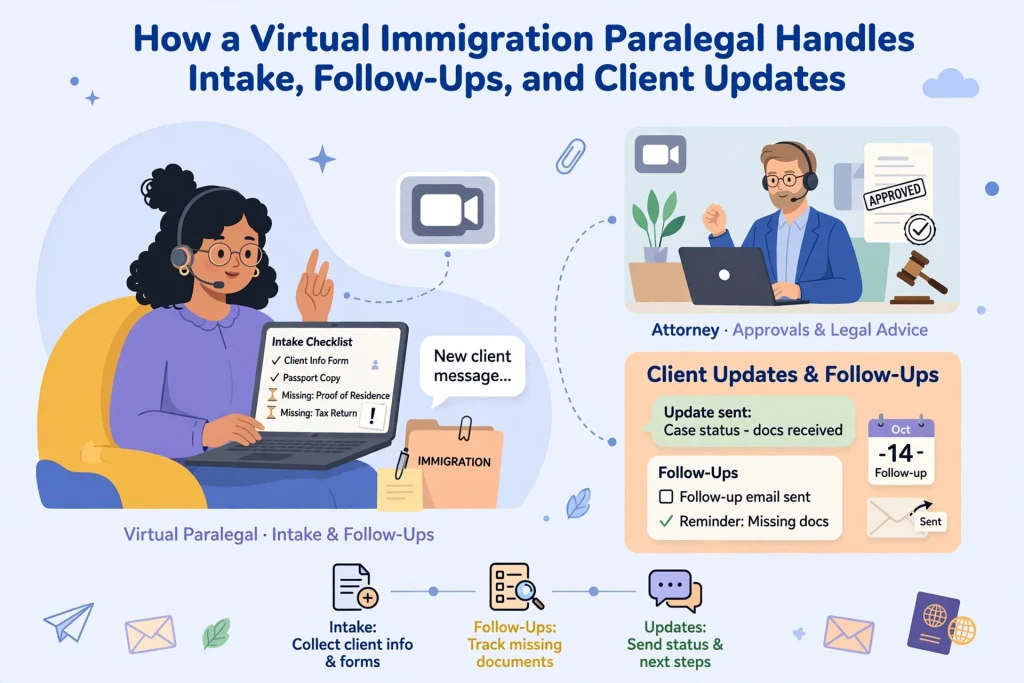
A virtual immigration paralegal handles intake by sending tailored questionnaires, chasing missing documents against a per-case checklist, and giving clients regular procedural updates — so cases start complete, clients stop calling for news, and attorneys step in only where legal judgment is needed.
Intake is where most cases stall. Not at the hearing, not at the filing — in week one, waiting for a document no one chased.
Step 1: The intake questionnaire
A good questionnaire captures the facts the attorney actually needs the first time: travel history, entries and exits, prior filings, family relationships, and employment history where relevant. A well-built questionnaire cuts the back-and-forth that stalls cases in week one.
The paralegal drafts, sends, and reviews the questionnaire, and flags gaps immediately — not after the attorney has already started drafting a filing on incomplete facts.
Step 2: Document collection and chasing
This is the step firms underestimate, and the step that saves the most attorney time:
• A per-case checklist — every document required, logged as received, pending, or outstanding.
• Scheduled follow-ups — polite, consistent chasing until the file is complete, so missing documents surface early instead of at filing.
• A handoff point — when a document raises a legal question (for example, a prior filing the client did not mention), the paralegal routes it to the attorney instead of deciding what it means.
Passports, birth and marriage certificates, tax records, pay stubs, and police clearances are all handled this way. The attorney should never be the person sending the third “just checking in” email about a birth certificate.
Step 3: Client status updates
Clients call for news because they do not have news. A trained paralegal fixes that with routine communication:
• Confirming receipt of documents.
• Explaining what happens next, in plain language.
• Answering procedural questions — timelines, appointments, what to bring — without touching legal advice.
Clients often prefer the faster response, and attorneys get back the hours previously spent on non-legal updates. The line is clear: procedural updates go to the paralegal; legal advice and strategy go to the attorney.
Step 4: Scheduling and the attorney handoff
Intake ends with a clean handoff: a complete file, a checklist showing what is ready, and a note on anything that needs attorney input. Biometrics appointments, interview notices, and reschedules are tracked from the same system, so a missed appointment — which can create months of delay — does not happen because no one owned the calendar.
What good intake looks like, week by week
Week | What should be true
Week 1 | Questionnaire sent, checklist created, first follow-ups sent
Week 2 | Missing documents identified, client updated, attorney flagged on gaps
Filing ready | Complete file, edition dates and fees checked, package ready for attorney review
If intake is still incomplete in week four with no follow-up log, the system is broken — not the client.
Frequently asked questions
Can a paralegal communicate directly with my clients?
Yes, for administrative matters: scheduling, document requests, status updates, and procedural explanations. Legal advice goes to the attorney.
What if a client is slow to respond?
That is the follow-up system’s job, not the attorney’s. Scheduled, documented follow-ups keep pressure consistent and polite, and create a record of what was requested and when.
How does intake connect to the rest of the case?
Intake sets up everything downstream: complete documents make form preparation faster, evidence packets stronger, and RFE responses easier. A weak intake creates rework at every later stage. See the full task list in What Does an Immigration Paralegal Do?
The bottom line: intake is not paperwork. It is the system that decides whether a case starts complete or stalls for weeks. A trained virtual paralegal owns that system — questionnaires, chasing, updates, and handoff — so the attorney starts with a ready file.
See how intake support works for your firm on our Paralegal Assistants page, or book a free session. SMY Solutions, Brooklyn, NY, (929) 327-5878.
Comments (0)
No comments yet. Be the first to share your thoughts.