
Virtual Immigration Paralegal Support by Case Type: Family, Asylum, Employment, and Removal
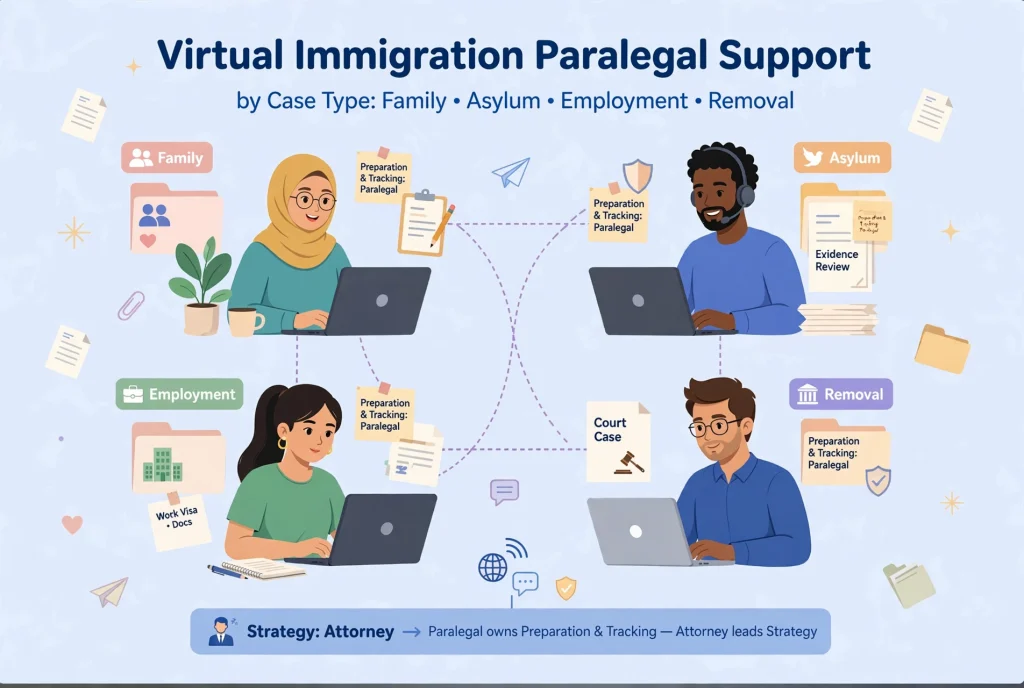
Virtual immigration paralegal support differs by case type: family cases need evidence and relationship documentation, asylum cases need declarations and country-condition research support, employment cases need employer documents and petition packages, and removal cases need EOIR docket discipline. In every type, the paralegal owns preparation and tracking; the attorney owns strategy and representation.
This guide maps support by case type, so you can see where delegation helps most in your practice. It covers workflow and support only — it does not give legal advice on any case type.
Family-based cases
Paralegal support: intake questionnaires covering family relationships, travel history, and prior filings; document collection (birth and marriage certificates, passports, tax records, pay stubs); I-130 petition preparation; evidence packets proving bona fide relationships; and priority-date tracking.
Attorney owns: eligibility, strategy, and the legal argument for the petition.
Where it helps most: document chasing. Family cases stall when one certificate or tax record is missing. A paralegal with a per-case checklist surfaces that gap in week one, not at filing.
Asylum and relief cases
Paralegal support: declaration drafting support (organising the client’s account into a clear timeline for attorney review); country-condition research support — news reports, human-rights documentation, and summaries organised into usable, cited files; evidence packets; and deadline tracking for filings and hearings.
Attorney owns: the legal theory, the declaration’s legal framing, and representation.
Where it helps most: research legwork and organisation. The attorney decides how country conditions fit the argument; the paralegal makes sure the research is gathered, organised, and ready to use.
Employment-based cases
Paralegal support: employer document collection (job descriptions, financial records, support letters); petition package preparation; edition-date and fee verification; and tracking of filing receipts and status updates.
Attorney owns: petition strategy, employer eligibility questions, and legal advice to the employer and beneficiary.
Where it helps most: package completeness. Employment petitions have many moving parts across employer and beneficiary. A checklist-driven paralegal keeps every part accounted for.
Removal and EOIR cases
Paralegal support: EOIR hearing calendars and filing deadlines, document preparation for attorney review, client scheduling and hearing preparation checklists, and tracking of court notices.
Attorney owns: representation before EOIR, strategy, and all court advocacy.
Where it helps most: docket discipline. EOIR dates do not forgive a missed calendar entry. A master calendar with advance reminders — separate from the USCIS calendar — is the core value here. See Deadline Management With a Virtual Immigration Paralegal in this series.
Frequently asked questions
Can one paralegal cover all four case types?
Yes, if they are immigration-trained across workflows — which is why training matters more than general experience. SMY paralegals are AILA-trained through American Immigration Lawyers Association (AILA) programs and resources, covering form families, evidence standards, and filing cadence across case types.
Does support change for high-volume firms?
The workflows stay the same; the system scales. High-volume firms need stronger intake triage, clearer checklists, and stricter deadline ownership — which is exactly what dedicated support with backup cover provides. See Hire an Immigration Paralegal in New York for the high-volume NYC profile.
What should a firm with mixed case types delegate first?
Start with the bottleneck: usually intake and document chasing, or deadline tracking. Add case-type-specific support after the first review, one workflow at a time.
The bottom line: case type changes the documents and the deadlines, not the division of labour. Paralegal owns preparation and tracking; attorney owns strategy and representation — in family, asylum, employment, and removal alike.
See the full task list in What Does an Immigration Paralegal Do?, or book a free session to map support to your case mix. SMY Solutions, Brooklyn, NY, (929) 327-5878.
Comments (0)
No comments yet. Be the first to share your thoughts.