
Hiring Immigration Paralegal Support for Your Small Law Firm: The 2026 Guide

If you run a small immigration practice and you are doing your own intake, your own filing prep, and your own deadline tracking, this guide answers the question directly: when is it time to bring in immigration paralegal support, should you hire in-house or outsource, and what do you ask before you sign anything?
When does a small immigration firm need paralegal support?
A small immigration firm needs paralegal support when the attorney is spending more than a few hours a week on administrative casework — intake, document prep, filing assembly, deadline tracking — instead of legal strategy and client counsel. The tipping point usually arrives well before the caseload feels unmanageable, because immigration work is deadline-driven: a missed USCIS filing date or an incomplete evidence packet has consequences that no amount of late nights can undo.

Sarah Jenkins
Senior Executive VA
Bilingual executive assistant with 4+ years managing C-level calendars, cross-timezone scheduling, and vendor correspondence with strict confidentiality.

David Miller
E-Commerce & Operations Assistant
Operational specialist helping US & UK Shopify store owners handle customer tickets, track supplier shipments, and reconcile daily orders.

Elena Rostova
Social Media Growth Manager
Creative strategist who scaled 3 B2B tech accounts to over 40k organic followers through high-retention carousels and viral short-form video strategies.

Marcus Vance
GoHighLevel & CRM Architect
Experienced CRM architect dedicated to building end-to-end sales pipelines, automated calendar bookings, and multi-channel lead reactivation workflows.

Alex Chen
Viral Short-Form Video Editor
High-energy editor specialized in YouTube Shorts, TikToks, and podcasts with over 15M aggregated views for direct response personal brands.

Jessica Taylor
Real Estate Transaction Coordinator
Dedicated real estate VA assisting US brokers with listing coordination, escrow deadlines, buyer CRM updates, and transaction compliance.
Here are the five signs, and they tend to show up in this order:
- The attorney is doing intake and data entry. If you are personally typing client details into intake forms, organizing evidence, or updating case-status spreadsheets, you are paying attorney rates for administrative labor. Every hour there is an hour not spent on strategy, hearings, or business development.
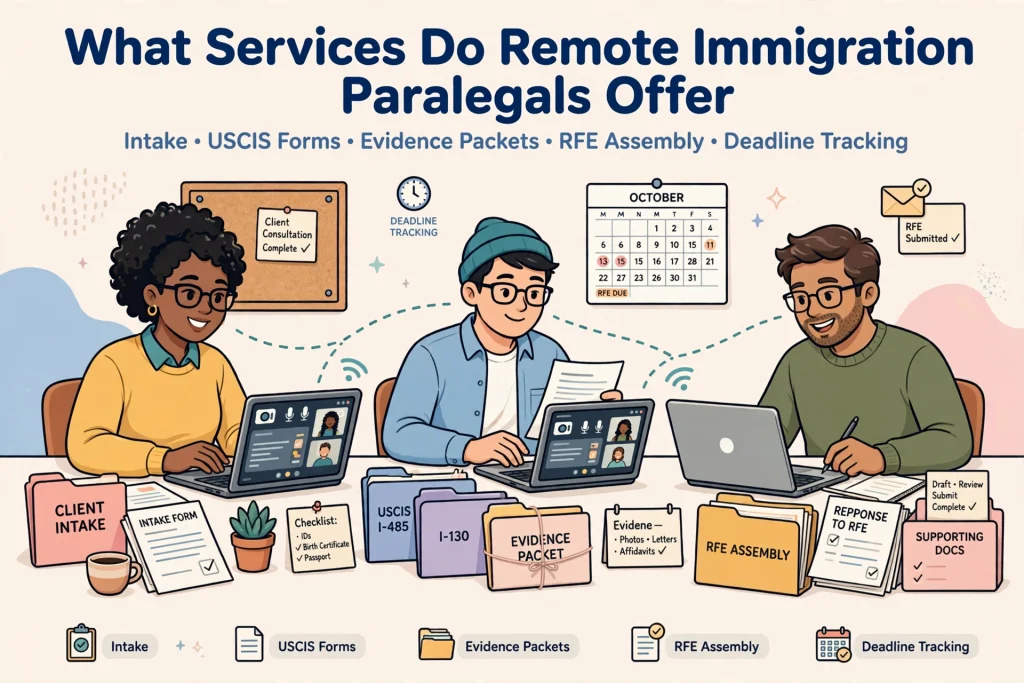
- Training churn is eating your calendar. You hire a general assistant, spend weeks teaching them which USCIS forms map to which benefit and how to assemble an RFE-proof packet, and then they leave — and the cycle starts over. The training tax on every hire is invisible until you add up the attorney hours.
- Deadlines have been missed or nearly missed. A biometrics appointment that almost slipped, a priority date no one was watching, a response deadline discovered at the last minute. In immigration practice, “nearly missed” is a warning light, not a relief. One actual miss can cost a client their status — and your reputation.
- The caseload is growing but headcount is not. You took on ten more cases this quarter with the same staff. Immigration files do not manage themselves; each one adds intake, evidence gathering, form preparation, and status tracking. Growth without support is just a slower way to burn out.
- Client communication is lagging. Clients calling for status updates you have not had time to send. Intake questionnaires sitting half-finished. In immigration practice, where clients are often anxious and the stakes are personal, slow communication turns into lost trust and lost referrals.
If two or more of these sound familiar, the question is no longer whether you need support — it is which kind.
Should a small firm hire in-house or outsource immigration paralegal support?
For most small firms, outsourced immigration paralegal support is the better fit until the firm has consistent, year-round demand of roughly 150 or more support hours per month. Below that threshold, a full-time in-house hire is over-buying: you pay a loaded salary whether the desk is full or not. Outsourced support converts that fixed cost into a flexible one.
The compact comparison:
| Factor | In-house paralegal | Outsourced immigration paralegal support |
|---|---|---|
| Typical monthly cost | ~$7,500 fully loaded (salary + ~30% benefits/taxes + overhead) | $1,500–$4,000 for part-time to full-time dedicated support |
| Best for | Consistent 150+ support hours/month, every month | Under ~90 hours/month average, or fluctuating caseloads |
| Immigration training | You train them — 2–4 months on USCIS forms, filing cadence, RFE handling | Pre-trained providers arrive knowing the forms and the USCIS rhythm |
| Coverage | None during sick days, vacations, or turnover | Provider bench keeps work moving |
| Control | Direct, in-person oversight | Remote — needs clear SOPs and a communication rhythm |
| Management | Recruiting, HR, reviews, training — all on you | Provider handles HR and training |
The training line is the one small-firm owners underestimate. A generalist in-house hire needs months to learn which form editions are current, how to build evidence packets that survive a Request for Evidence, and how to track priority dates and receipt numbers across dozens of files. That is two to four months of paying a full salary for partial productivity. A trained outsourced immigration paralegal starts producing in week one. For firms doing mostly family-based petitions, naturalization, or asylum work, that head start is often the deciding factor.
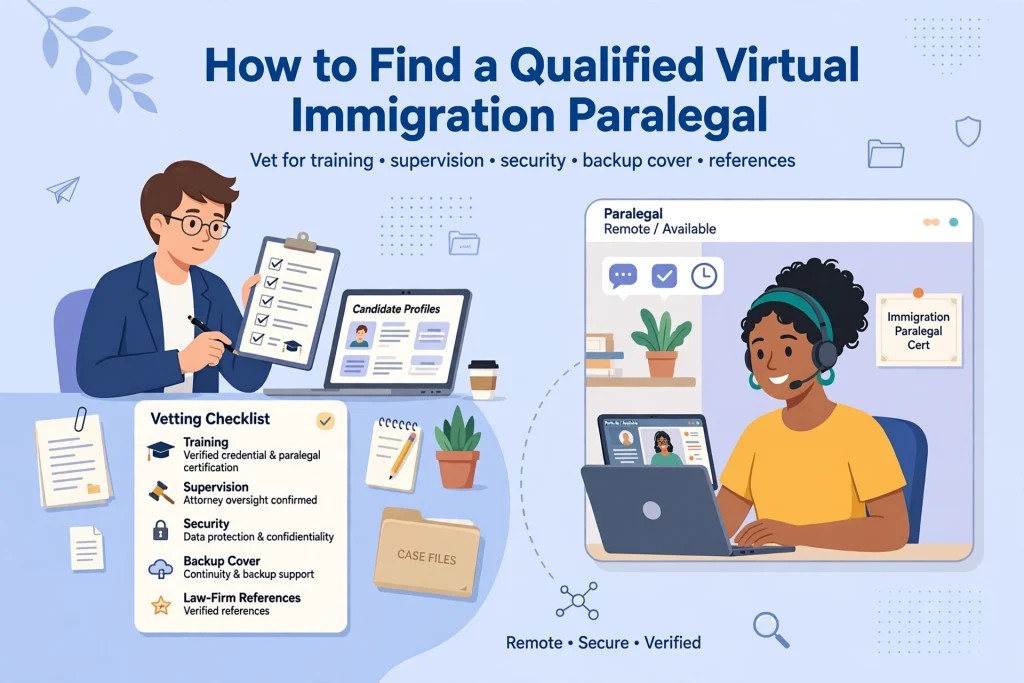
How do you vet an immigration paralegal provider? (7 questions to ask)
Ask about immigration-specific training, the attorney-supervision model, data security, backup coverage, communication, pricing, and references — and listen for specifics, not adjectives. “Trained” and “secure” mean nothing until the provider tells you exactly what the training covers and exactly how data is protected. Here is the checklist, with what a good answer sounds like:
- What does your immigration training actually cover? A good answer names specifics: USCIS form families (I-130, I-485, N-400, I-589 and their companions), current edition dates, evidence-packet assembly standards, how to handle RFEs, priority-date and receipt-number tracking, and EOIR basics if they support removal work. If the answer is “our team is experienced,” ask for the curriculum. (Our answer: SMY Solutions paralegals are AILA-trained — trained through American Immigration Lawyers Association programs and resources.)
- How does attorney supervision work? Every paralegal must work under the direction of a licensed attorney — the ABA’s ethics framework and every state bar require it. A serious provider describes the workflow: who reviews drafts, who signs off before anything is filed, how errors get caught, and how they handle the line between support and unauthorized practice. If a provider is vague here, walk away.
- How do you protect sensitive client data? Look for signed NDAs, encrypted communication and storage, device-level security policies, and a clear confidentiality workflow — in writing, before you sign. Immigration files contain passports, financial records, and asylum narratives; “we take security seriously” is not a policy. Ask for the actual practices.
- What happens when my assistant is unavailable? A real provider has a trained bench and a handoff protocol so your deadlines keep moving during sick days and vacations. A solo freelancer has an out-of-office reply. In immigration practice, where filing windows do not pause, backup coverage is not a nice-to-have.
- How do we communicate day to day? Defined channels beat good intentions: a shared task board, a daily or weekly check-in rhythm, agreed response times. Ask what tools they use and how intake documents flow from your clients to the assistant and back to you for review. Unclear communication is the number-one reason remote legal support fails.
- Is the pricing truly all-inclusive? Confirm there are no add-on fees for software access, background checks, replacements, or “account management.” The quote should be the invoice. Also ask how scaling works — what happens to the rate when you go from 40 to 80 hours a month, or need a second assistant during a busy season.
- Can I speak with two current law-firm clients? References from actual attorneys — not testimonials on a landing page — are the fastest credibility filter there is. Ask specifically for firms doing immigration work, and ask those references about deadline reliability and how the provider handled a high-pressure filing.
How fast can immigration paralegal support start?
Outsourced immigration paralegal support typically starts within one to two weeks of engagement; hiring in-house usually takes six to ten weeks before the new hire is productive, plus two to four more months of immigration-specific training. When your caseload is already pressing, that difference is the whole decision.
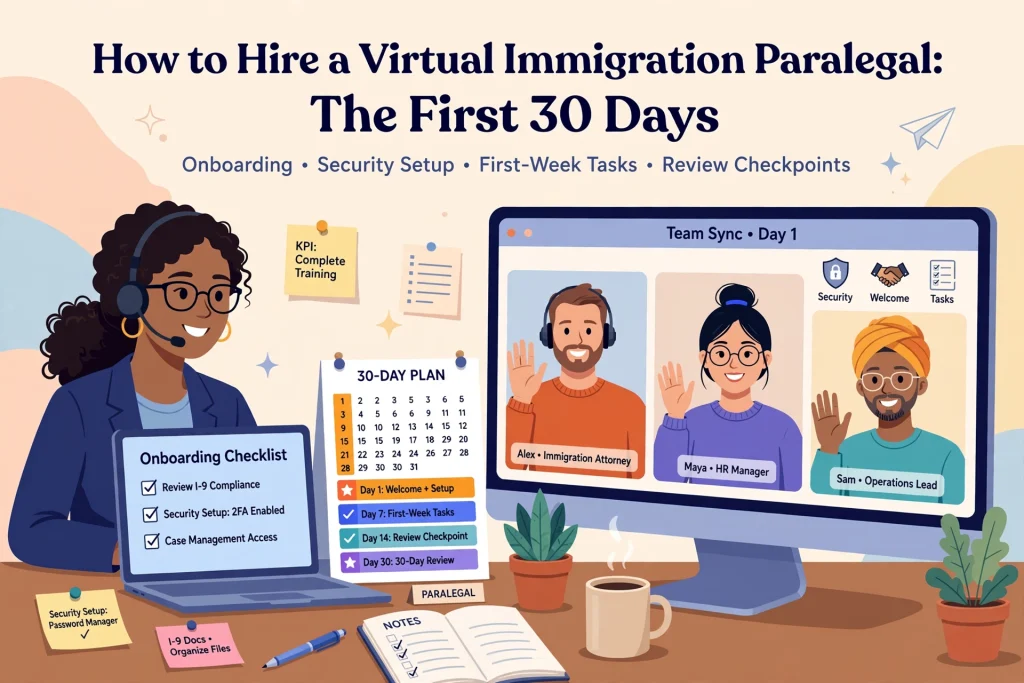
Here is what a proper outsourced onboarding looks like:
- Week 1: Systems access and security setup (case-management software like Clio, shared drives, encrypted communication channels), NDA execution, and a walkthrough of your intake templates, filing checklists, and communication preferences. The provider shadows your current workflow rather than imposing their own.
- Week 2: The assistant begins handling live work under your review — intake processing, evidence organization, draft form preparation — with a defined check-in rhythm so you can calibrate quality early. By the end of the second week, routine casework should be flowing through them.
Compare that with in-house: job posting, resume review, interviews, background checks, offer negotiation, and notice periods routinely consume six to ten weeks — and the hire then needs months of immigration-specific training before they are net-positive. If you are hiring because deadlines are already tight, the in-house timeline does not solve this quarter’s problem. Outsourced support does.
Frequently asked questions
Can virtual immigration paralegals handle sensitive client data?
Yes — with proper vetting. Immigration files contain some of the most sensitive documents in legal practice, and reputable providers handle them daily under signed NDAs, encrypted storage and communication, and device-level security policies. The security question is about the provider’s documented practices, not the assistant’s location. Get the specifics in writing before you engage.
Does outsourced paralegal support still require attorney supervision?
Always. Legal ethics rules require that paralegals — in-house, freelance, or virtual — perform substantive work under the direction and supervision of a licensed attorney. A reputable provider builds this into the model: the attorney reviews drafts, signs off on filings, and remains responsible for the work product. This applies equally to immigration casework.
How many hours of support does a small immigration firm typically need?
Most solo and two-attorney immigration firms find they need 40–90 hours of paralegal support per month — intake processing, evidence gathering, form prep, deadline tracking, and client follow-up. That band is exactly where outsourced dedicated support wins: it is far less than a full-time hire, and the hours flex with filing seasons.
What is the difference between a virtual immigration paralegal and a general VA?
A general virtual assistant can learn your systems, but an immigration-trained paralegal arrives already knowing USCIS form families, filing cadence, RFE response structure, and deadline-tracking discipline. For a small firm, that difference is measured in months of training you do not have to provide and errors you do not have to catch.
When should a small firm switch from outsourced support to an in-house hire?
When the firm’s paralegal workload is consistently above roughly 150 hours a month, twelve months a year, and the matters benefit from daily in-person presence — courthouse runs, in-person intake, paper-file workflows. Until then, outsourced support delivers the same output at a fraction of the fixed cost, with backup coverage an in-house hire cannot provide.
The bottom line: most small immigration firms do not have a staffing problem — they have a timing problem. The attorney is doing work a trained assistant could do, the training cycle repeats with every generalist hire, and deadlines do not wait for onboarding. Pre-trained immigration paralegal support closes that gap in one to two weeks, at a cost that flexes with your caseload.
If your firm is at that tipping point, start here: explore our Paralegal Assistants service to see how trained virtual immigration paralegal support works in practice. And for the fuller picture of what specialized support takes off an attorney’s plate, read Immigration Casework Support: Why Specialized Paralegal Help Matters.
Comments (0)
No comments yet. Be the first to share your thoughts.